
Ski Helmet Buying Guide
Choosing a ski helmet is one of the most important decisions you'll make when buying your ski equipment.
The highest-specification helmet isn't necessarily the right one for you. A helmet has to suit both the size and shape of your head, and getting the fit right comes before comparing additional safety features.
Our aim is to help you find the helmet that fits your head properly. Once you've achieved the correct fit, you can then decide which additional safety features are right for you.
Fit Comes First
If there is one piece of advice we would like you to remember from this guide, it is this:
Fit comes first.
A ski helmet should feel gently snug around your head.
It shouldn't feel painfully tight or create uncomfortable pressure points, but equally it shouldn't wobble or rotate excessively.
One practical check is to see whether the helmet can rotate around your head. A correctly fitting helmet should not be able to rotate past your temples.
Occasionally, a helmet can simply look too large on somebody. If it sits unusually high rather than settling naturally around the head, this can indicate that the internal shape isn't right for the wearer.
A helmet that doesn't suit your head shape is usually evident quite quickly once you try it on. Unlike ski boots, you don't normally need to wear a helmet for an extended period before deciding whether the basic shape and fit are right.
Size Is Only the Starting Point
When buying a ski helmet, the first step is usually to measure your head circumference.
This helps you choose which helmet size to try, but it doesn't tell you whether the helmet will fit correctly.
Heads with exactly the same circumference can have noticeably different shapes. The internal shape of one helmet may feel comfortable and secure, while another helmet in the same stated size may create pressure points, sit too high or move around excessively.
This is why the size shown on the label is only the starting point.
The shape of the helmet needs to work with the shape of your head.
Only once you try the helmet on can you properly assess this.
Buying Your Ski Helmet In Store or Online
Whenever possible, we recommend buying your ski helmet from a specialist retailer where you can try different brands, models and internal shapes.
We'd be delighted to welcome you to our Harrogate showroom. If travelling to us isn't practical, we encourage you to visit your nearest specialist ski retailer.
If neither option is possible, buying online is still a perfectly reasonable choice.
Start by measuring your head circumference carefully and use the individual manufacturer's sizing information to select the appropriate size.
Once the helmet arrives, remember that the measurement was only the first part of the process. You must still assess whether its shape, comfort and security are right for your head.
Don't keep a helmet simply because the circumference measurement suggests that it should fit.
If it doesn't feel right, try another style or manufacturer.
Buying a Ski Helmet for a Child
The same fitting principles apply to children's ski helmets as they do to adult helmets.
One mistake we occasionally see is parents trying to buy a helmet one size larger so that their child can grow into it and use it for longer.
We don't recommend this.
A child's ski helmet needs to fit correctly now, not after they have grown into it.
If a helmet is too large, it cannot fit as intended, regardless of how much adjustment is available within the helmet.
Helmet and Goggle Compatibility
A ski helmet and goggles need to work comfortably together, but we don't believe that eliminating every millimetre of space between them should necessarily be the objective.
In our experience, a slight gap of a few millimetres between the helmet and the top of the goggles can be beneficial.
This allows air to reach the upper ventilation area of the goggles and can help reduce the risk of fogging.
Some manufacturers incorporate ventilation channels intended to direct airflow from the goggles through the helmet, and these systems can work very well. However, from our own skiing experience, we still prefer a small natural air gap rather than pressing the goggles tightly against the helmet.
We mean a few millimetres, not a few centimetres. A large gap can indicate that the helmet and goggles aren't particularly compatible.
We will cover further advice on preventing goggles from fogging in our Ski Goggles Buying Guide.
Visor Ski Helmets
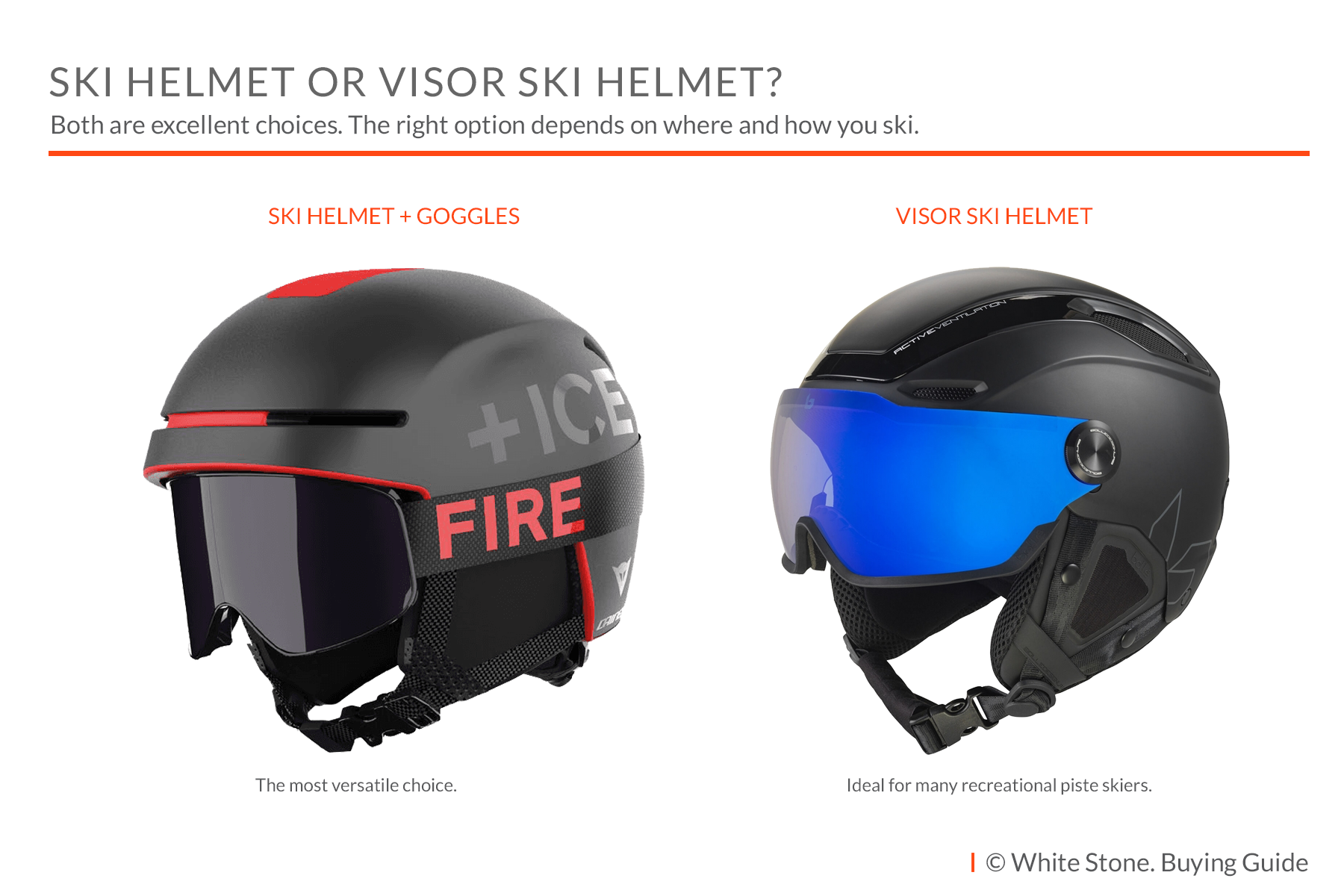
Visor helmets can be an excellent choice for the right skier.
In our experience, they are particularly popular with relaxed piste skiers who value convenience, clear vision and not having to manage a separate pair of goggles.
Visors also tend to allow some airflow around the sides, which many wearers find comfortable.
However, visor helmets tend not to form the same seal against the face as a separate ski goggle.
In deep powder, snow can therefore enter more easily around the visor. For this reason, we generally don't recommend visor helmets for powder skiing or regular off-piste use.
Skiers who regularly ski fast, aggressively or away from prepared pistes also tend to prefer the closer fit and seal provided by conventional goggles.
This doesn't make a visor helmet better or worse. It simply makes it more suitable for certain types of skier and conditions.
Safety Standards and Additional Technologies
Every ski helmet we sell complies with the relevant recognised ski helmet safety standards.
Once you've established that a helmet fits correctly, you can then compare the additional safety technologies and refinements offered by different models.
Generally, moving higher through a manufacturer's range will bring additional safety features, more sophisticated construction, improved ventilation, finer adjustment and other comfort refinements.
Many of the helmets we sell incorporate MIPS, or Multi-directional Impact Protection System.
MIPS is designed to help reduce rotational forces reaching the brain during certain angled impacts.
Other helmets may use different construction methods or additional technologies intended to manage impact forces in other ways.
These features are all worth considering, but even the most sophisticated helmet technology cannot compensate for poor fit.
What Can a Ski Helmet Protect You From?
A ski helmet is an important piece of safety equipment and should always be worn.
However, no ski helmet can guarantee that the wearer will avoid serious injury in every accident.
The circumstances and forces involved in skiing and snowboarding accidents vary enormously, and no manufacturer or retailer can responsibly promise that a helmet will prevent every type of head injury.
A correctly fitted, certified ski helmet is designed to provide an important level of protection, but it should never be regarded as guaranteeing the wearer's safety.
Hats, Goggles and Helmet Liners
We occasionally see customers considering a slightly larger helmet so they can wear a thick hat underneath it.
We don't recommend this.
Ski helmets are not designed or tested to be worn over ordinary hats or with goggles positioned underneath the helmet.
You may see younger freestyle skiers wearing their equipment in this way, but that doesn't mean the helmet has been designed or tested for that type of use.
All the helmets we sell can accommodate only a very thin liner, such as a Helmaclava, for particularly cold conditions.
Helmaclavas don't appear to be widely used by most of our customers skiing in Europe, but they can be useful for very cold conditions, including colder times of the season or destinations such as Canada.
The helmet should be fitted while wearing only what you genuinely intend to use beneath it.
Caring for Your Ski Helmet
A ski helmet should be treated with the same care as any other item of safety equipment.
When travelling by air, pack your helmet in the centre of your luggage and surround it with soft clothing. Placing clothing inside the helmet can also help protect it and make effective use of the space.
Try to ensure the helmet cannot move freely around your case or be crushed by harder items.
On the mountain, avoid leaving it somewhere it could fall, be knocked from a bench or be accidentally kicked in a busy restaurant.
Clean the outer shell using warm water and a soft damp cloth only.
Some removable liners can be washed, but always check and follow the manufacturer's instructions for the individual helmet.
Be careful when handling a helmet while wearing rings or other jewellery. Tapping or slapping the helmet with a ring can scratch or mark the outer shell.
While some surface marks may be cosmetic, we believe all safety equipment should be handled carefully and unnecessary damage avoided.
How We Pack and Inspect Ski Helmets
Before dispatch, we carry out multiple visual quality checks to help ensure every ski helmet leaves us in perfect condition.
Each helmet is supplied in its original manufacturer's helmet box. We then place that box inside a second outer shipping carton to help protect both the helmet and its packaging during delivery.
Should you need to return a helmet, it must be returned in the same way: inside its original manufacturer's box, protected by a suitable outer packaging box.
Please don't attach courier labels, tape or other adhesive materials directly to the manufacturer's helmet box.
Because a helmet is an item of safety equipment, we cannot make exceptions to this returns requirement.
We hope this careful approach gives you peace of mind that the helmet you receive has been checked and handled with the same care that we require when it is returned.
When Should a Ski Helmet Be Replaced?
It isn't possible to give one answer that covers every knock, drop or accident.
The severity of the incident, the construction of the helmet and any visible signs of damage all need to be considered.
Many lightweight ski helmets use EPS foam. If an EPS helmet has suffered a significant impact or drop, inspect it carefully and replace it if there are signs of damage or if you believe its integrity may have been compromised.
Helmets using EPP foam can generally tolerate more minor knocks, but they should still be carefully inspected for signs of damage.
A major fall, forceful impact or substantial drop should always be taken seriously, regardless of the type of foam used.
If you are uncertain about the condition or integrity of your helmet, the safest practical decision is straightforward:
Replace it.
The White Stone View
Choosing a ski helmet doesn't need to be complicated.
Remember four simple principles:
Fit comes first.
Size is only the starting point.
Shape matters more than most people realise.
Then consider additional safety technologies.
Whenever possible, visit a specialist ski retailer and try different helmets in person.
We'd be delighted to help you in our Harrogate showroom. If visiting us isn't practical, please try your nearest specialist retailer. If buying online is your only realistic option, begin with an accurate head measurement and then carefully assess the fit and shape once the helmet arrives.
Don't choose a helmet solely because it is a particular brand, has the longest specification or is the size your measurement suggested.
The right ski helmet is the one that fits your head properly.
We hope our guide has helped you understand how to choose the right ski helmet. If you have any further questions, please get in touch—we're always happy to help.
© White Stone. Buying Guide.
Based on over 20 years of fitting premium ski wear and more than 40 years of skiing experience.