
Ski Layers Buying Guide
What Should I Wear Underneath My Ski Jacket?
It's one of the questions we're asked most often in our Harrogate showroom.
The answer isn't simply a baselayer and a midlayer. The right combination depends on your ski jacket, the weather, how actively you ski and how warm or cold you naturally feel.
At White Stone, we stock everything from highly technical baselayers and leggings to colourful, fashion-led ski layers designed to coordinate with each season's ski wear. Whether technical or fashion-led, everything we stock has been selected because it works well as ski wear.
The purpose of layering isn't simply to keep you warm. It's to help you stay comfortable as your activity level and the mountain conditions change throughout the day.

Why Do Skiers Wear Layers?
Many people think of layers simply as a way of adding warmth.
Warmth is certainly important, but controlling heat and moisture is just as important.
Skiing can take you from working hard and generating considerable body heat on a long or challenging run to sitting almost completely inactive on a cold chairlift a few minutes later.
Good layers help manage these changes by allowing excess heat and moisture to move away from your body while retaining warmth when you need it.
This is often referred to as moisture management.
The objective isn't to wear as many layers as possible. It's to wear the right combination for you, your ski jacket and the conditions.
Understanding Ski Layers
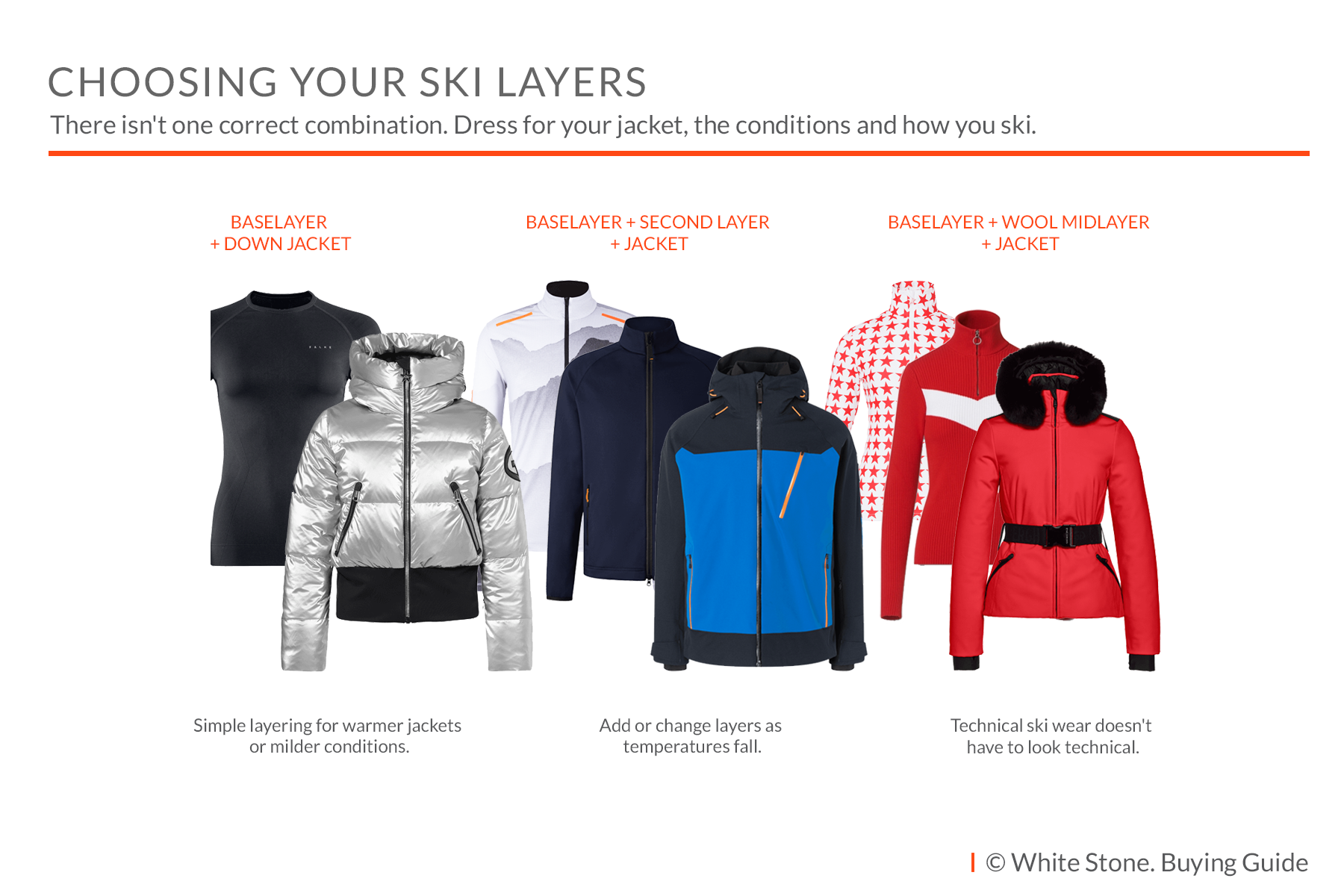
Most skiers think in terms of a first layer or baselayer and a second layer or midlayer.
That's a useful starting point, but it doesn't tell the whole story.
Both baselayers and midlayers are available in different thicknesses, fits and levels of warmth.
On one day you might wear:
Close-fitting baselayer → Ski jacket
On a colder day:
Close-fitting baselayer → Lighter second layer → Ski jacket
And when more warmth is required:
Close-fitting baselayer → Warmer midlayer → Ski jacket
That lighter second layer doesn't necessarily need to be something described as a midlayer. A slightly more casually fitted baselayer can work extremely well over a close-fitting first layer.
If you're wearing a shell jacket with little or no insulation of its own, you may need to build considerably more warmth underneath.
There isn't one correct combination.
Building Your Layering System
Your ski jacket should always influence what you wear underneath it.
A warm insulated, down or bonded-down jacket may require relatively little underneath in milder conditions. A shell jacket provides weather protection but little insulation of its own, so the layers underneath become much more important in determining how warm you are.
The weather matters too.
The combination that's comfortable on a sunny spring day is unlikely to be the combination you choose on a very cold January morning.
And then there's you.
Some skiers naturally feel the cold, while others generate considerable heat as soon as they start skiing.
This is why regular skiers often build up a selection of different layers over time. Having lighter and warmer options allows you to choose the combination that suits the weather, the jacket you're wearing and how you expect to ski that day.
You don't wear everything together. You simply have more options.
Choosing a Baselayer
For most skiers, a technical baselayer is the most versatile starting point.
A baselayer should normally sit relatively close to the body without feeling like compression clothing. This allows it to work comfortably underneath additional layers while helping to manage heat and moisture.
Some baselayers have a highly technical appearance, while others are colourful and fashionable.
Don't assume one is more technical simply because it looks more technical.
Brands such as Falke produce highly technical-looking baselayers, while many premium ski-fashion brands offer prints, colours and designs created to coordinate with their ski jackets and pants.
These fashion-led pieces can still be highly technical garments.
Once you've established that a layer is suitable for skiing, the decision can therefore be as much about fit, feel and personal style as appearance.
Merino Wool or Polyester Baselayer?
Both merino wool and polyester can make excellent ski baselayers, but they have slightly different strengths.
If a customer tells us they particularly feel the cold, we will often recommend a merino wool baselayer.
Merino provides excellent warmth while also managing heat and moisture very effectively. Our Falke merino baselayers are the warmest baselayers we stock and are particularly suited to skiers who naturally feel the cold.
For someone who tells us they perspire heavily, we are more likely to recommend a polyester technical baselayer.
Polyester absorbs very little moisture and generally dries more quickly than wool, making it particularly useful for skiers who generate a lot of heat and perspiration.
That doesn't mean merino is poor at moisture management — far from it. The choice is more about deciding which characteristics are most useful to you.
What About Baselayer Leggings?
The choice of baselayer leggings is usually more straightforward.
Within our main technical range, we generally offer a merino option for extra warmth and a polyester option for warmth with excellent moisture management and quicker drying.
Length is also worth considering.
If you're buying leggings specifically for skiing, we generally prefer three-quarter length. This keeps unnecessary fabric out of the ski boot and avoids bunching around the lower leg.
Full-length leggings can be a more versatile choice if you also intend to use them for other sports or outdoor activities.
When skiing in full-length leggings, we recommend pulling or folding the bottom of the legging up so that it finishes above the ski boot rather than tucking it inside.
What About Cotton?
Cotton is often dismissed completely as a skiing layer because it absorbs moisture and dries considerably more slowly than many technical fabrics.
For someone skiing hard, becoming hot and perspiring heavily, this can be a genuine problem. Once damp, cotton can retain that moisture and may leave you feeling cold when your activity level drops or you're sitting on a chairlift.
However, we don't believe that means cotton should automatically be ruled out for every skier.
Cotton can feel extremely warm and comfortable for someone who skis relatively gently and doesn't tend to overheat or perspire heavily.
Some regular skiers know their own skiing very well. They may return to the same resort, enjoy familiar easier runs and ski at a fairly consistent level of exertion. For them, a cotton layer can work perfectly well in the right conditions.
We occasionally stock cotton ski layers ourselves where we believe they offer a useful option.
For someone new to skiing, or anyone unsure how much they'll perspire, a technical baselayer remains the safer and more versatile starting point.
The important thing is understanding how you ski and how much heat and moisture you generate.
When Cotton Causes Problems
We occasionally speak to customers who tell us that a high-quality ski jacket didn't keep them warm.
When we ask what they wore underneath it, the answer can sometimes help explain why.
A thick cotton rugby shirt, for example, may absorb perspiration while you're skiing and retain that moisture. When your activity level falls, the damp layer can then make you feel surprisingly cold.
The ski jacket hasn't necessarily failed. The layer underneath has made it much harder for the complete clothing system to manage moisture effectively.
Choosing a Midlayer
When White Stone first opened, the classic fleece dominated the market.
There was good reason for that. Fleeces were warm, practical and represented excellent value.
However, many traditional fleeces could also feel relatively bulky underneath a fitted ski jacket and didn't always move particularly well against the outer layer.
Modern ski midlayers have evolved considerably.
Many fleece-style garments now effectively reverse the traditional construction, with a smoother surface towards the outerwear and the softer, fluffier fleece towards the first layer. This allows the layers to move over each other more easily and can make the complete layering system feel much less restrictive.
We've also seen après-ski layers evolve into excellent technical second layers, giving skiers a fabulous heritage ski-fashion style both on and off the slopes.
Woollen jumpers themselves are nothing new to skiing — they've kept skiers warm for generations. What's changed is the choice available.
Modern wool, wool blends and technical fabrics can provide warmth with less bulk, while full-zip midlayers, lightweight fleeces and fashion-led second layers give customers far more ways to build their layering system.
Today there really is a ski layer to suit almost every taste.
Whether you prefer a technical fleece, a lightweight full-zip midlayer, a heritage-inspired knit or a colourful printed baselayer, technical performance and ski style can now sit very comfortably together.
Don't Over-Layer
Adding another layer every time the temperature falls can seem logical, but more isn't always better.
Too many bulky layers can restrict movement and alter the fit of your ski jacket.
More importantly, if you become too warm while skiing, you'll perspire more. Once your clothing becomes damp, remaining comfortable when your activity level drops becomes more difficult.
Sometimes choosing a warmer individual layer is better than simply adding another garment.
This is also why it's important to think about your normal layering system when buying a ski jacket.
A jacket that fits perfectly over a baselayer may become restrictive if you subsequently try to put several bulky layers underneath it.
Why Does Breathability Matter?
Breathability can sound like another technical ski-wear specification, but its benefit is quite simple.
When you're skiing and generating heat, your body also produces moisture.
Your first layer helps move that moisture away from your skin, but that's only the start. The moisture then needs to continue through your second layer and ultimately through your outer ski wear.
This is why we prefer to think of your ski clothing as a complete system.
A highly breathable baselayer can't perform at its best if the layers worn over it prevent moisture from escaping.
Equally, an excellent ski jacket will struggle to keep you comfortable if a damp layer underneath is retaining perspiration.
The more effectively the complete system manages heat and moisture, the longer you're likely to remain comfortable as your activity level and the mountain conditions change.
Why Do Ski Layers Vary So Much in Price?
This is a very reasonable question.
You can buy a ski layer from an outdoor retailer for around £40 made from 100% polyester and find another 100% polyester ski layer costing several times as much.
Looking only at the fibre-content labels, it can be difficult to understand the difference.
But 100% polyester doesn't tell you everything about the finished garment.
The quality of the fibres and yarns, fabric construction, weight, stretch, finishing, seams, shaping and overall feel can all differ.
With premium ski wear, you may also be paying for more considered design, exclusive prints, detailing and colours developed to coordinate with the season's ski collection.
Some of these differences are surprisingly difficult to communicate in words or through an online photograph.
In our showroom, a customer can try a more affordable layer and then a premium alternative with a very similar stated fibre content. Often, the difference becomes apparent simply from how the garments feel and fit.
That doesn't make the more affordable layer a poor choice.
Everything we stock is selected to work properly as ski wear. Beyond that, the decision can simply come down to how much you value those additional qualities — and sometimes how much you feel like treating yourself.
Getting the Fit Right
Your first layer should generally sit relatively close to the body without feeling like compression clothing unless that's specifically what you want.
A second layer can have a slightly more relaxed fit, but it still needs to sit comfortably underneath your ski jacket without creating unnecessary bulk.
If possible, try your layers with the jacket you intend to wear.
Think about the complete combination, rather than assessing every garment in isolation.
As with all ski wear, don't become too attached to the size printed on the label. The correct size is the one that gives you the intended fit and works comfortably with the rest of your ski clothing.
Building Your Ski Wardrobe
You don't need every possible combination for your first ski holiday.
A good technical baselayer and an appropriate ski jacket provide a sensible starting point.
As you ski more regularly, you'll learn whether you naturally run warm or cold, how much you perspire and which combinations work best for you.
Over time, you might add a warmer merino baselayer, a lighter polyester option, a casual second layer, a full-zip midlayer or a favourite wool knit.
That choice allows you to look at the day's weather and select what you think will keep you most comfortable.
Just as a regular skier may eventually own different ski jackets for different conditions, building a choice of layers gives you greater flexibility without requiring you to wear more of them at once.
Caring for Your Ski Layers
Always follow the care instructions for the individual garment.
Technical fabrics, merino wool, other wool blends, cotton and fashion-led layers can all have different washing requirements.
Avoid assuming that a warmer wash will clean something better. If the care label specifies a low temperature, follow it.
Fabric conditioner should generally be avoided on technical garments where the manufacturer advises against it, as it can affect the performance of some fabrics.
Wool garments may require a wool-specific washing programme or detergent and should always be treated according to their individual care instructions.
And, as with our other ski wear, hand washing isn't automatically the gentlest option. Water that feels comfortably warm to your hands may be hotter than the temperature specified on the care label.
Proper care will help preserve the fit, appearance and performance of your ski layers.
The White Stone View
There isn't one perfect layering system.
Start by considering your ski jacket, the weather, how actively you ski and whether you naturally feel warm or cold.
Don't add layers simply because you've been told that skiing requires a certain number.
On one day, a baselayer and warm ski jacket may be all you need. On another, a lighter second layer or warmer midlayer may make the difference. If you're wearing a shell, you'll generally need to create more of your warmth underneath it.
As you ski more regularly, building a selection of different layers gives you the flexibility to adapt.
Technical performance matters, but so do fit, comfort, feel and style.
A more affordable ski layer can perform extremely well. Choosing a premium alternative may simply be because you appreciate its fit, feel, design or finish.
Ultimately, the best layering system is the one that helps you remain comfortable and enjoy your skiing as the weather and your activity level change throughout the day.
We hope our guide has helped you understand how to choose and combine your ski layers. If you have any further questions, please get in touch—we're always happy to help.
© White Stone. Buying Guide.
Based on over 20 years of fitting premium ski wear and more than 40 years of skiing experience.