
Ski Socks Buying Guide
Many skiers spend hundreds of pounds choosing the right ski boots but give very little thought to the socks they wear inside them. In reality, your ski socks are the only layer between your feet and your ski boots, making them one of the most important pieces of ski equipment for comfort, warmth and control.
Unlike an ordinary sports sock, a quality technical ski sock has been specifically designed for skiing. Modern ski socks combine targeted cushioning, support, moisture management and carefully selected fabrics to improve comfort while maintaining the close boot contact needed for good ski control.
There isn't one "best" ski sock. The best ski sock is the one that best matches your ski boots and your feet.
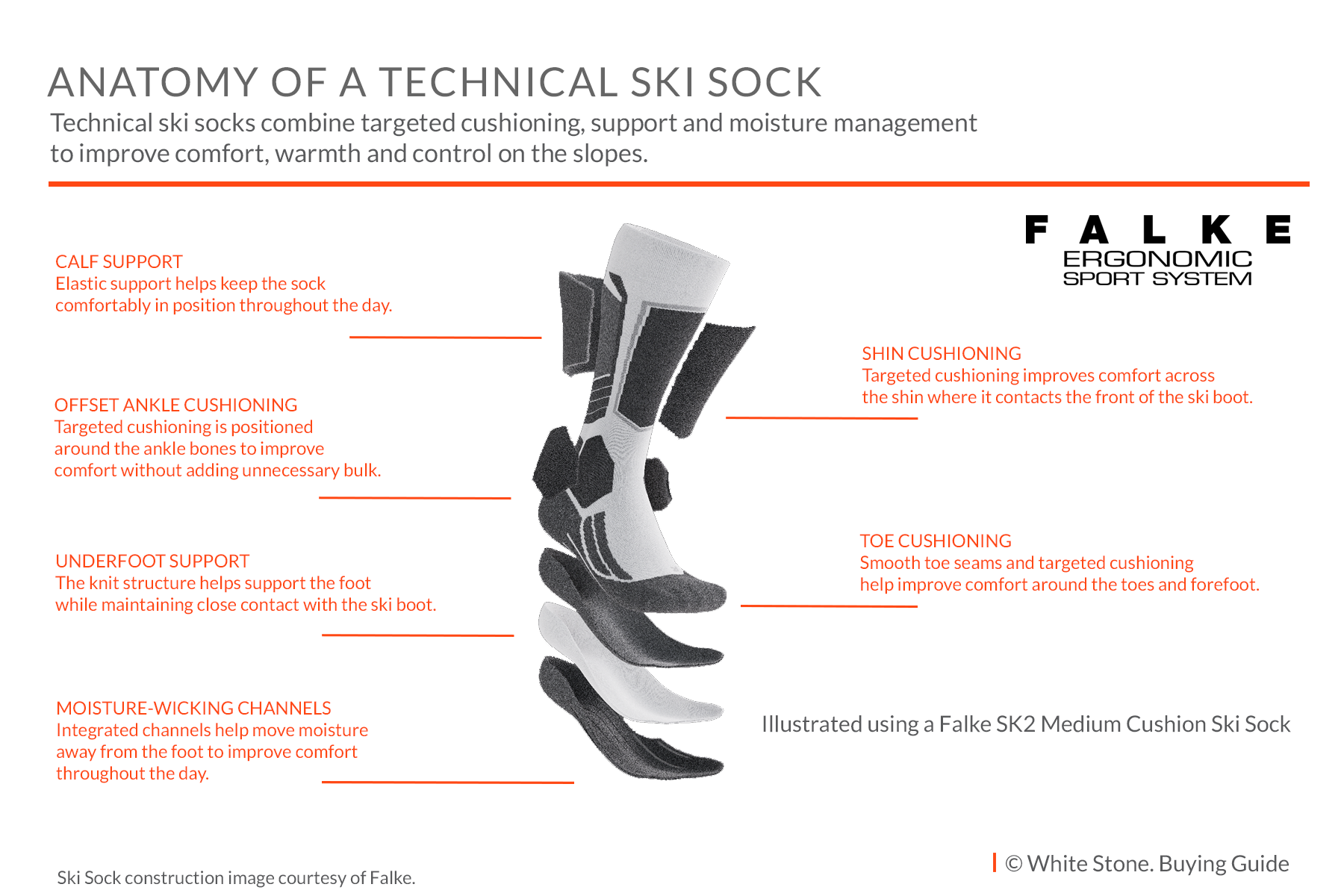
Anatomy of a Technical Ski Sock
A quality ski sock is much more than a long, warm sock. Ski-specific construction can combine targeted cushioning, support and moisture management in different areas of the foot and lower leg.
How We Help Customers Choose Ski Socks
When customers visit our showroom, we don't begin by asking which ski sock they'd like. We first establish a few simple facts that help us recommend the most suitable option.
1. Do You Hire Ski Boots or Own Your Own?
Our first question is usually:
The answer usually tells us where to start.
Rental boots are designed to fit a wide range of foot shapes and are often slightly roomier than your own ski boots. A medium or extra cushioned ski sock can help take up some of this additional space.
If you own your own ski boots, we then consider how they fit. Are they new and close fitting, or have you owned them for several years and found that they now have a little more room?
Close-fitting ski boots often work best with a lighter cushioned ski sock, while older or roomier boots may benefit from additional cushioning.
2. Consider the Shape of Your Feet
Every foot is different, so as well as considering your ski boots, it's important to consider the shape and volume of your feet.
Skiers with a high instep or higher-volume feet will often benefit from a lighter cushioned sock. Even a relatively small increase in sock volume can create unnecessary pressure across the top of the foot.
Skiers with lower-volume feet may prefer a little more cushioning, particularly if there is some additional space inside the ski boot.
This is another reason why there is no single ski sock that will be right for everybody.
3. Choosing the Correct Cushioning (Sock Volume)
The amount of cushioning – and therefore the overall volume of the sock – should be chosen primarily to suit your ski boots and your feet, rather than simply your skiing ability.
Light Cushioning
Lightly cushioned ski socks are generally suited to close-fitting ski boots, including many professionally or custom-fitted boots. They maintain close boot contact while still providing cushioning in key areas.
Medium Cushioning
For most skiers, medium cushioning offers the best of both worlds, combining excellent comfort with good boot contact.
If you're buying ski socks as a gift or simply aren't sure which cushioning level to choose, medium cushioning is usually the safest option and suits the majority of skiers.
Extra Cushioning
Extra cushioned ski socks are often suited to roomier ski boots, particularly rental boots or older boots that have gained a little extra space over time.
It is important to remember that more cushioning does not automatically mean warmer feet. Too much sock volume inside a close-fitting ski boot can restrict circulation, potentially leaving your feet colder rather than warmer.
Quick Guide – Which Ski Sock Should I Choose?
The table below is intended as a starting point only. The most suitable ski sock will always depend on your ski boots, how they fit and the shape of your feet.
| Your Situation | Recommended Cushioning | Why? |
|---|---|---|
| You hire ski boots | Extra / Medium | Rental boots are often slightly roomier and may benefit from the additional sock volume. |
| You own close-fitting ski boots | Light / Medium | Maintains close boot contact without adding unnecessary volume. |
| Your own ski boots have become a little roomier | Medium / Extra | Additional cushioning can help take up some of the extra space inside the boot. |
| You have a high instep | Usually Light | Lower sock volume can help avoid unnecessary pressure across the top of the foot. |
| You're buying ski socks as a gift | Medium | The safest choice for the majority of skiers when their boot fit is unknown. |
| You're simply not sure | Medium | An excellent starting point for most skiers. |
This table is a guide only. Foot shape and ski boot fit can change which cushioning level is most suitable.
Should You Wear Two Pairs?
We occasionally discover that a customer is wearing two pairs of ski socks, often when they are trying to improve warmth or comfort.
We don't recommend wearing two pairs of ski socks.
Modern technical ski socks are designed to be worn as a single layer. Wearing two pairs increases bulk, can create wrinkles or bunching and may restrict circulation inside the ski boot. The result can be less comfort and colder feet.
How many pairs you take on a ski holiday is, of course, a different question. Some skiers prefer a fresh pair every day, while others take fewer pairs and wash them during the holiday. This depends on personal preference and the washing facilities available.
Choosing the Correct Size
Choosing the correct size is just as important as choosing the correct cushioning.
Unlike everyday shoes, you should never buy ski socks with extra room at the toes. A correctly sized ski sock should fit smoothly from heel to toe without excess material.
Many people wear a shoe size slightly larger than the actual length of their feet. A technical ski sock is designed to stretch and conform to the foot, so choosing the smaller sock size when between sizes usually provides a smoother fit with less excess material inside the ski boot.
Wrinkles or loose fabric inside a ski boot can quickly become uncomfortable during a day's skiing.
Merino Wool or Synthetic?
Today's premium ski socks often combine Merino wool with technical synthetic fibres rather than relying entirely on one material.
Merino wool offers excellent temperature regulation, softness and natural odour resistance, while synthetic fibres can improve durability, moisture management, stretch and shape retention.
The resulting blend allows manufacturers to position different fibres exactly where their particular properties are most useful.
Why We Recommend Falke
Many manufacturers produce excellent technical ski socks. However, if budget allows, we continue to regard Falke as the benchmark.
Their extensive range of cushioning options and precise size-specific construction make it easier to match the sock to both the skier and their ski boots. Their anatomically shaped left and right socks are also designed around the differing shape of each foot.
Choosing between Falke models is therefore less about buying a "better" sock and more about selecting the right level of cushioning and fit for your ski boots and your feet.
We also offer more affordable ski sock options for customers who don't necessarily require the same level of size-specific or anatomical construction.
Caring for Your Ski Socks
Always follow the manufacturer's washing and care instructions. Technical ski socks use a combination of specialised fibres, stretch zones and cushioning, and correct washing will help maintain their fit and performance.
Avoid fabric conditioner unless specifically permitted by the manufacturer, as it can affect the moisture-management properties of some technical fibres.
Still Not Sure Which Ski Sock Is Right?
Choosing the correct ski sock isn't simply about buying a thin or thick sock. The best choice depends on your ski boots, how they fit and the shape of your feet.
A good ski sock can improve comfort and help your ski boot fit as intended, but it cannot correct a ski boot that is the wrong size or shape. Persistent pressure points, discomfort or shin pain should not simply be addressed by adding more sock cushioning – the underlying ski boot fit may need to be considered.
Drawing on many years of ski boot fitting experience, we're always happy to advise on how your ski boots and your feet should influence your choice of ski socks. If you're unsure whether light, medium or extra cushioning is most suitable, please ask – we're happy to help.
© White Stone. Buying Guide. Based on over 20 years of fitting premium ski wear and more than 40 years of skiing experience.