
Ski Goggles Buying Guide
Choosing the right ski goggles isn't simply about choosing the lens colour you like or the latest lens technology. Fit comes first. Then choose your lens for the range of light and visibility you may encounter — not simply the lens that looks best in the mirror.
In our Harrogate showroom, we start by finding goggles that fit the customer's face. Once we have established which goggles fit, we can then discuss lens category, colour, photochromic options and the other features that may be useful.
There are many technical terms used to describe the different components in ski goggles, but you don't need to understand all of them to make a good choice.
Fit Comes First
A ski goggle should sit comfortably against your face, with the foam making good contact without uncomfortable pressure points or obvious gaps.
Face shapes vary, as do goggle shapes. A goggle that fits one person beautifully may simply not suit another.
This is why, where possible, we recommend trying ski goggles on rather than choosing purely by their stated size.
Ideally, try your goggles with your ski helmet. In our experience, once you've found a goggle that is the correct size and shape for your face, most will work comfortably with your ski helmet.
You don't normally need to buy the same brand of goggles and helmet. Manufacturers understandably design and promote their own helmet and goggle combinations, but we regularly fit goggles and helmets from different brands together successfully.
We don't believe you need an absolutely seamless fit between the top of the goggle and helmet. In fact, we prefer a very small gap of a few millimetres, which can provide useful airflow around the upper goggle vents and help reduce the possibility of fogging.
We are talking about a few millimetres — not a large gap.
Choosing the Right Goggle Size
Ski goggles are available in different frame sizes, and we identify the size where appropriate on our individual product pages.
As a general guide, women often choose small to medium frames and men medium to large, but this should only be regarded as a starting point. Face shape and personal preference matter more than gender.
Children's goggles are generally sized using an age guide. Again, this is only a guide. Parents will usually know whether their child's head and face are relatively small, average or large for their age, and this should be taken into account when selecting a size.
Don't assume that a larger goggle is technically better simply because oversized goggles are fashionable. A goggle still needs to fit your face correctly and work comfortably with your helmet.
Ultimately, the correct size is the one that fits your face properly.
Do I Have to Wear Ski Goggles?
Some skiers simply don't enjoy wearing goggles and would prefer to ski in sunglasses whenever possible.
Suitable sports sunglasses can certainly be an option in the right conditions, but in our opinion a correctly fitting ski goggle provides the best all-round eye protection while skiing.
Goggles provide much greater coverage around the eyes, helping protect them from wind, cold air, falling snow and airborne ice or snow particles, as well as providing appropriate protection from bright sunlight and UV when fitted with a suitable lens.
Sunglasses leave considerably more of the eye area exposed and can become uncomfortable in strong wind, snowfall or at higher skiing speeds.
Some people also find their eyes particularly sensitive to cold air and wind, which can make the greater coverage provided by goggles considerably more comfortable than sunglasses.
For this reason, although appropriate sports sunglasses have their place, we regard ski goggles as the best all-round choice for skiing.
Choosing the Right Lens
Once we have found goggles that fit correctly, the next consideration is the lens.
The important thing isn't simply whether you're skiing somewhere sunny or somewhere renowned for poor weather. Light and visibility can change enormously during a single ski day.
Even with clear skies forecast, you can ski from a sunny south-facing slope onto a north-facing slope in January where direct sunlight may not reach the snow at all.
You might experience excellent visibility on one run and significantly flatter light on the next — and then emerge into bright sunshine again part-way down.
This is why we encourage customers to think about the range of light and visibility they may encounter, rather than trying to predict one particular type of light for their holiday.
What Does Light Transmission Mean?
When looking at ski goggle specifications, you'll often see a light transmission percentage, sometimes referred to as VLT (Visible Light Transmission).
Put simply, this tells you how much of the available light the lens allows through to your eyes.
A higher percentage allows more light through and is generally better suited to lower-light conditions. A lower percentage blocks more light and is generally better suited to brighter conditions.
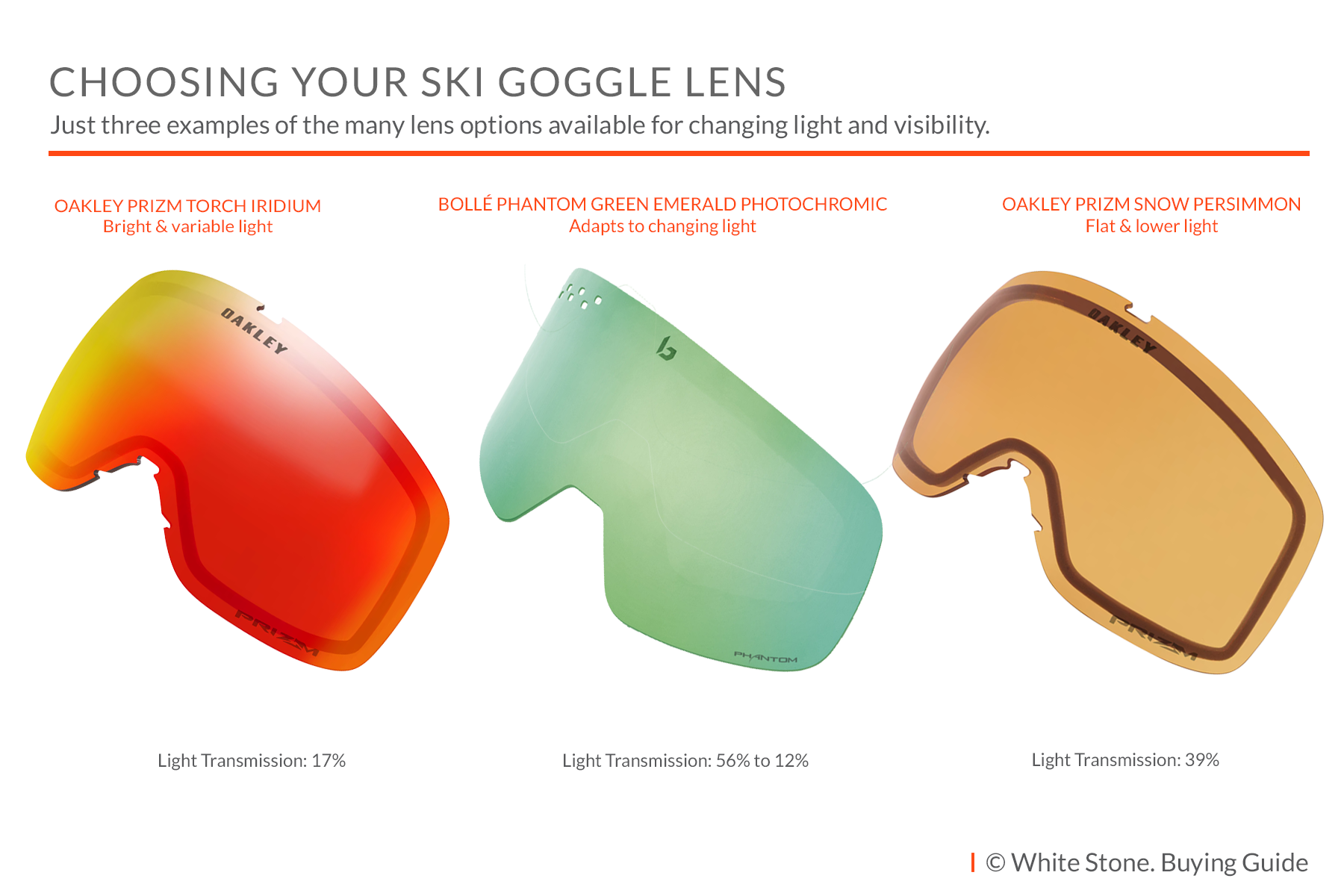
For example, a lens with 39% light transmission allows considerably more light through than one with 17%.
Photochromic lenses are different because their light transmission changes as the available light changes. A lens with a range of 56% to 12%, for example, can become lighter in poorer light and darker in brighter light.
You don't need to become too concerned with the numbers. They are simply a useful way of understanding how light or dark a lens is and comparing different options.
Understanding Lens Categories
Ski goggle lenses are commonly classified by category according to how much visible light they allow through.
Category 1 – designed for low-light and poor-visibility situations.
Category 2 – a versatile option capable of dealing with a broad range of light.
Category 3 – intended principally for brighter, sunnier conditions.
Category 4 – very dark lenses intended for exceptionally bright conditions and not something we commonly recommend for normal resort skiing.
The precise light transmission varies between individual lenses, so always check the manufacturer's specification rather than relying on the category alone.
Why Category 2 Is a Popular All-Round Choice
For many skiers, Category 2 is a popular all-round choice.
It provides useful protection in brighter light while still allowing enough light through to perform well when visibility deteriorates.
You could carry different lenses and stop to change them as the light changes. In reality, stopping at the top of a chairlift to change your lens isn't always convenient — and your friends or family may not be particularly patient while you do it!
More importantly, the light can change again part-way down the run.
A Category 2 lens therefore provides a useful compromise for many skiers.
However, Category 2 isn't automatically right for everybody or every situation.
If you're particularly sensitive to bright light, or you're spending sustained periods skiing in strong sunshine, a darker Category 3 lens may be more appropriate. Suitable sports sunglasses can also be useful in bright conditions when goggles aren't required.
Your own comfort and sensitivity to bright light should always be considered when choosing a lens.
What About Yellow Lenses for Flat Light?
A yellow lens can be extremely effective in flat light and poor visibility.
However, the lens that performs best in poor light isn't necessarily the lens you want to wear for the entire day.
A strong yellow low-light lens can become too intense when you suddenly emerge into bright sunshine.
This is another reason Category 2 is such a popular all-round option rather than choosing a lens specifically for the poorest visibility you might encounter.
Lens Colour Is Personal
Lens category tells you how much light passes through the lens, but the colour or tint you personally prefer is another consideration.
Orange and pink or rose lenses are common examples, and different people can find that they see contrast better through different colours.
This is something that can take years of skiing to discover.
When I worked on the World Cup ski tour in the late 1980s and early 1990s, orange lenses were extremely common among racers. Look at top-level ski racing today and you'll see a much wider variety of lens colours and categories being used.
Even at the highest level, personal preference plays a part.
Understandably, we can't allow customers to take new goggles skiing to test different lens colours. However, as you become a more regular skier, you may occasionally have the opportunity to try a friend's goggles with a different lens and discover that a particular tint works particularly well for your eyes.
There isn't necessarily one lens colour that everybody sees through equally well.
What Colour Are You Actually Looking Through?
Most quality ski goggles now use double-lens construction. The two lens layers help provide insulation and reduce the likelihood of condensation forming on the inner surface.
There's another detail that isn't always obvious when looking at goggles online or on display:
The colour you see when looking at a goggle isn't necessarily the colour you'll see when looking through it.
A goggle can have a dark, neutral or highly reflective appearance from the outside while using a rose, orange or another coloured tint to influence the view and contrast experienced by the wearer.
This is why we don't recommend choosing a ski goggle simply by looking at its lens colour from the outside. The important thing is how the complete lens performs when you look through it.
Photochromic Ski Goggles
If you want greater versatility from a single lens, a high-quality photochromic lens is an excellent option to consider.
Photochromic lenses react to the available light, becoming lighter or darker as the light changes.
Depending on the particular lens, some photochromic goggles can cover a very broad range — for example, approximately Category 1 through to Category 3.
That makes them particularly useful on days when you repeatedly move between bright sunshine and poor or flat light.
Photochromic goggles are a more significant investment, but for a skier who wants one lens capable of adapting to changing light throughout the day, the additional versatility can make that investment worthwhile.
Interchangeable Lenses
Another solution is a goggle supplied with interchangeable lenses.
You might, for example, have a darker lens for bright sunshine and a lighter lens for poor visibility.
This can work extremely well, but before choosing this system we ask customers a very practical question:
Will you actually carry the spare lens?
If you ski with a small rucksack, carrying a properly protected spare lens may be straightforward.
Without one, carrying a relatively large polycarbonate lens safely can be inconvenient. A spare lens sitting in your hotel room isn't much use when the visibility changes on the mountain.
There is also the practical inconvenience of stopping to change it — particularly when the light can change several times during a single run.
Polarised Ski Goggle Lenses
Polarised lenses are designed to reduce reflected glare, particularly light reflecting from the surface of the snow. This can make vision feel more comfortable in bright conditions.
You may sometimes hear the argument that polarised ski goggles can make patches of ice more difficult to identify because they reduce some of the reflected light that can help make an icy surface visible.
There is some logic to this. However, we don't believe it means polarised lenses should automatically be avoided for skiing. Reducing glare can also provide considerable benefits.
As with the other lens technologies in this guide, we wouldn't choose a goggle simply because it is polarised. Fit comes first, followed by choosing a lens suitable for the range of light and visibility you may encounter.
If the goggle fits correctly and you like the view through the lens, we regard polarisation as a useful feature to consider rather than something that should discourage you from choosing that goggle.
Lens Quality & Clarity
Much of the technology in a good ski goggle is hidden.
Two lenses can look remarkably similar on display while differing in optical quality, lens material, coatings and construction.
As you move through the ranges, part of the additional investment can go into better optical clarity and more sophisticated lens technology, rather than something immediately visible.
Some higher-specification lenses use materials such as Trivex, which can provide excellent optical clarity while remaining lightweight and impact resistant.
This doesn't mean everybody needs the highest-specification lens available. It simply explains why comparing goggles by appearance alone doesn't necessarily tell you everything about the lens you're looking through.
Cylindrical or Spherical Lenses?
You'll frequently see ski goggles described as cylindrical or spherical.
These terms principally describe the shape of the lens.
A cylindrical lens curves predominantly across your face, while a spherical lens curves both horizontally and vertically.
There are technical differences between the two constructions, but we wouldn't make this one of the first things you consider when buying ski goggles.
Correct fit and lens choice are more important.
Both designs can make excellent ski goggles.
Can Ski Goggles Fog?
Yes.
This is something we believe is important to be realistic about.
Manufacturers invest considerable effort in anti-fog coatings, ventilation and double-lens construction, and these technologies can significantly reduce the likelihood of fogging.
However, no ski goggle can guarantee that it will never fog.
If moisture gets into the goggle, warmth from your face and head can cause that moisture to evaporate. When the warm, moist air meets the colder lens, condensation can form.
Anti-fog technology helps, but the laws of physics still apply.
One of the most effective things you can therefore do is surprisingly simple:
Keep your goggles as dry as possible.
Don't Let Snow Collect on Your Goggles
Everyone now wears helmets, so goggles naturally get placed onto the helmet when people stop.
Firstly, don't simply push your goggles upwards against the helmet. Repeatedly dragging the foam against the helmet can damage it.
Instead, gently pull the goggles away from your face before placing them just above the rim of the helmet.
But there is another consideration when it's snowing.
It's common to see skiers standing at the top or bottom of a lift chatting with their goggles sitting on their helmet while snow collects against the upper foam.
Heat from your head can begin melting that snow. The foam absorbs the moisture and the goggle becomes wet.
You then place the damp goggle back against your warm face with relatively little airflow around it — exactly the circumstances that can encourage fogging.
When it's snowing heavily, try to keep your goggles in position over your eyes whenever practical rather than allowing snow to accumulate against the foam.
If you're sitting outside having a drink, consider taking them off completely and putting them safely inside your ski jacket where they can remain warm and dry.
What If Your Goggles Get Covered in Snow?
Sometimes getting them wet is unavoidable.
A fall in powder can completely cover your goggles with snow.
If that happens, try to gently brush or blow away the snow before it melts into the foam.
Likewise, prolonged snowfall can eventually make any goggle damp. During a break, taking the goggles off and keeping them somewhere warm and dry can help.
What you shouldn't do is try to solve the problem with excessive heat.
Never Dry Ski Goggles on a Radiator or by a Fire
Mountain restaurants often have skiers' gloves and goggles lined up near radiators or fires.
Avoid doing this.
Excessive heat can damage the materials and adhesives used in a ski goggle, including the adhesive securing the foam to the frame.
If the foam separates because the goggles have been subjected to excessive heat, that is damage rather than a manufacturing fault.
Allow wet goggles to dry naturally rather than trying to accelerate the process with high temperatures.
Ski Goggles Over Glasses
Many ski goggles are designed to accommodate prescription glasses, often with cut-outs in the frame or foam to provide space for the arms of the glasses.
Be realistic about the size and shape of the glasses you intend to wear underneath them.
A larger spectacle frame requires more space, and you may need to choose a slightly larger goggle to accommodate it comfortably — provided the larger goggle still fits your face correctly.
Wherever possible, try the goggles while wearing your own glasses.
Your glasses shouldn't be excessively compressed against your face or prevent the goggle from fitting correctly.
The Goggle Strap & Helmet Retainer
Quality ski goggles commonly have silicone strips on the inside of the strap to help the strap grip the surface of the helmet. All of the ski goggles we currently offer have this feature.
Most ski helmets also have a clip or retainer at the back designed to help keep the goggle strap in position.
Together, these help prevent the strap moving unnecessarily on the helmet, but the rear retainer shouldn't be thought of as permanently attaching the goggles to it.
Choosing a Goggle You Actually Like
Once you've established that a goggle fits correctly and you've chosen a lens suitable for the range of light and visibility you may encounter, there's absolutely nothing wrong with choosing the one you like the look of most.
Ski goggles are part of modern ski wear, and there is considerable choice in frame shapes, sizes, colours and lens finishes.
At White Stone, we try to combine well-known specialist goggle brands with some more unusual and exclusive options. Our collections include brands such as Bollé, Oakley and Giro, alongside limited-edition Bogner goggles that we select each season.
Some customers want a classic goggle they'll happily use for years. Others enjoy finding a frame and lens that works particularly well with their helmet and ski wear.
Once the fit and lens are right, personal choice should absolutely be part of the decision.
The White Stone View
Choosing ski goggles doesn't need to become overly technical.
Start with fit.
Then choose your lens for the range of light and visibility you may encounter, remembering that this can change dramatically during a single day's skiing.
For many skiers, Category 2 can provide an excellent balance across a broad range of light. If you want greater versatility from one lens, consider a high-quality photochromic option. If you prefer interchangeable lenses, be realistic about whether you'll actually carry the spare.
Don't assume the darkest or most reflective lens is automatically the best. A darker lens may look fantastic, but if visibility deteriorates, you may wish you'd chosen something that allows more light through.
And remember that even the best anti-fog technology works most effectively when you help it by keeping your goggles as dry as possible.
Ultimately, the right ski goggle is one that fits properly, works with your helmet, provides appropriate vision for the light and visibility you encounter and is something you enjoy wearing.
We hope our guide has helped you understand how to choose the right ski goggles. If you have any further questions, please get in touch—we're always happy to help.
© White Stone. Buying Guide.
Based on over 20 years of fitting premium ski wear and more than 40 years of skiing experience.