
Ski Jacket Buying Guide
Choosing the right ski jacket isn't simply about finding the warmest or most waterproof option. The best ski jacket is the one that suits where and when you ski, the conditions you are likely to encounter, how you personally feel the cold and what you intend to wear underneath it.
At White Stone, these are some of the first things we consider when helping a customer choose a ski jacket. We will usually ask how regularly you ski, where you are going and, importantly, whether the resorts and times of year you ski tend to vary.
There isn't one ski jacket that is perfect for every mountain and every condition. Understanding the differences allows you to choose the jacket that is right for you.
Where and When Are You Skiing?
This is one of the most important questions we ask in our Harrogate showroom.
The altitude of the resort, the height of the ski area and the time of year can make a considerable difference to the conditions your jacket may encounter.
Take two popular French resorts as an example. Morzine sits at approximately 1,000m, with skiing extending to around 2,300m, whereas Val d'Isère village sits at approximately 1,850m and its ski area reaches around 3,500m.
Someone skiing in Morzine at Christmas therefore has a greater possibility of encountering wet snow or rain on the lower slopes than someone skiing in Val d'Isère in February. Wet conditions can occur anywhere in the mountains, but they are much less common on the higher slopes of Val d'Isère during the colder part of the season.
This doesn't make one resort better than the other. It simply illustrates why where and when you ski matters when choosing a jacket.
Altitude is something we also encourage customers to consider when choosing a resort. When booking a ski holiday well in advance, lower resorts at around 800–1,200m cannot offer the same snow reliability as higher-altitude destinations. Where customers have flexibility over their destination, we often suggest looking at resorts around 1,500m or higher, particularly when snow reliability is an important consideration.
If you're buying for your first ski trip, we recommend choosing something appropriate for the conditions you can reasonably expect. A regular skier visiting different resorts throughout the season may place greater importance on versatility and may eventually choose to own different jackets for different conditions.
Which Type of Ski Jacket?
The majority of ski jackets we sell at White Stone fall into three main categories:
Waterproof insulated jackets, down jackets and bonded-down jackets.
We also offer a small selection of men's shell jackets and occasionally more specialist fashion or warm-weather jackets.
None is automatically better than another. They have different strengths.
Waterproof Insulated Ski Jackets
A waterproof insulated ski jacket is an excellent all-round choice, particularly if you want one jacket capable of dealing with a wide range of mountain weather.
The waterproof outer construction provides protection from wet snow and rain, while the insulation provides warmth.
We are particularly likely to recommend considering this type of jacket if you regularly ski at lower-altitude resorts or at times of year when temperatures and precipitation can be more variable.
However, waterproof doesn't necessarily mean extremely warm. The amount and type of insulation varies considerably between jackets, so warmth and waterproofing should be considered separately.
Down Ski Jackets
Down ski jackets are popular because they can provide excellent warmth without excessive weight.
Traditionally, down ski jackets use natural duck or goose down. Some down-style jackets instead use loose synthetic fibres designed to mimic the loft and feel of natural down. Where appropriate, we identify the type of insulation in our individual product information.
One misconception worth addressing is that a down jacket shouldn't be worn when it is snowing.
Snow itself isn't the problem.
A well-made down ski jacket can cope extremely well with snowfall, including heavy snowfall when temperatures are cold. We wouldn't discourage someone from wearing a traditional down jacket in Val d'Isère in January simply because heavy snow is forecast.
The greater consideration is prolonged wet weather, rain or very wet snow.
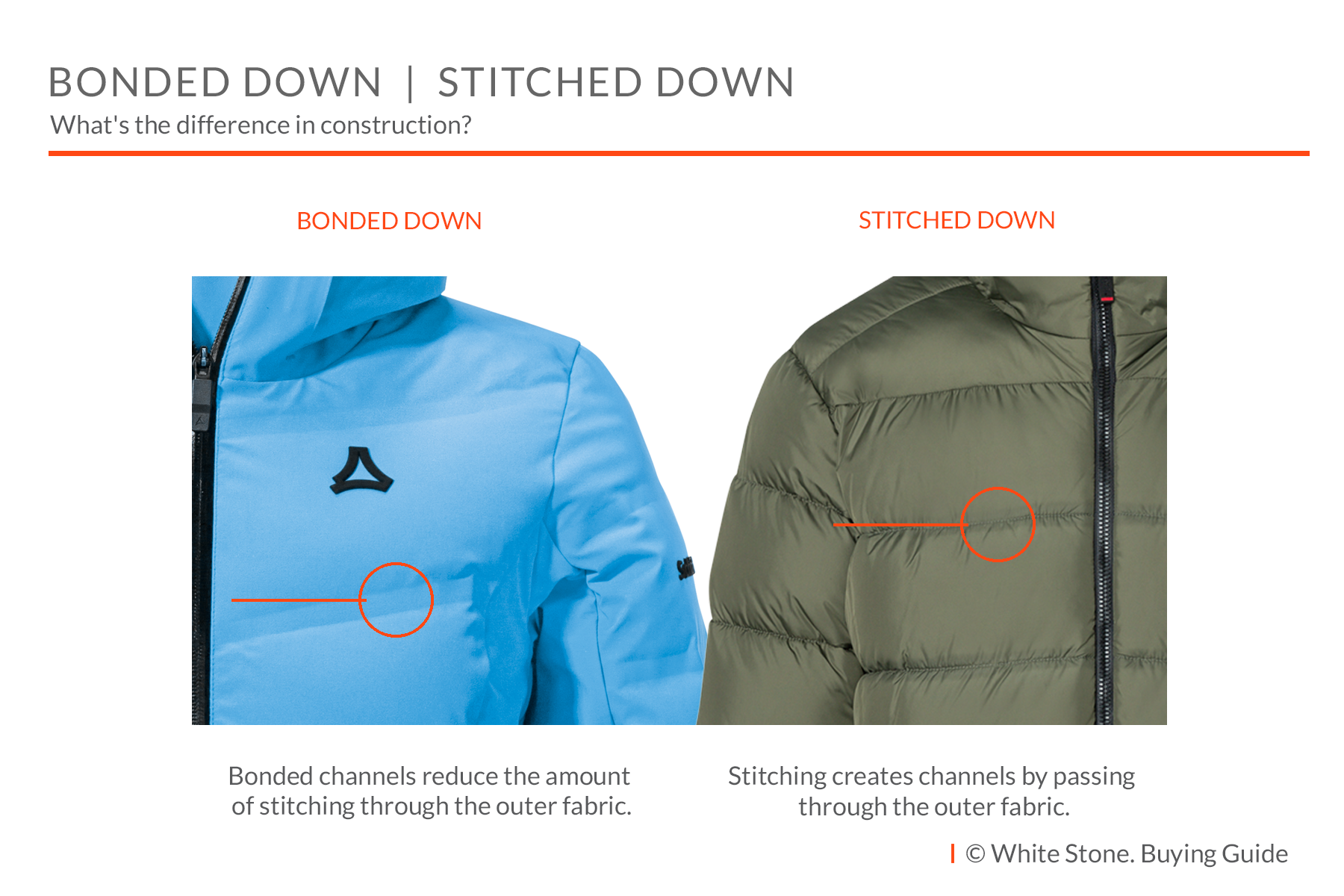
Traditional down jackets are commonly constructed using stitching to create the individual chambers that hold the down. Even when the outer fabric itself has a waterproof specification, those seams and areas of stitching can mean the complete garment doesn't provide the same protection as a waterproof ski jacket where the stitched seams are fully or critically taped.
For that reason, at White Stone we generally describe traditionally stitched down ski jackets as water resistant rather than waterproof.
A Note About Waterproof Claims
This is an area where our descriptions can occasionally differ from a manufacturer's terminology.
A brand may describe a ski jacket as waterproof because the outer fabric has a waterproof specification. At White Stone, we prefer to consider the construction of the complete garment.
Seams, stitching, zips and the way the jacket has been constructed all contribute to how we believe it will perform in prolonged wet conditions.
We may therefore describe a jacket as water resistant even where the manufacturer's information describes its fabric as waterproof.
That doesn't mean the jacket cannot cope with snow. It simply means we wouldn't promise the same protection in prolonged wet conditions that we would expect from a waterproof ski jacket where the stitched seams are fully or critically taped to help prevent water penetrating through the construction.
We prefer to give our customers a realistic assessment of the complete garment rather than simply repeat the specification of the fabric.
Bonded Down Ski Jackets
Bonded-down construction can offer an excellent compromise for someone who wants the warmth and feel of a down ski jacket with greater protection from wet weather.
On a conventionally constructed down jacket, stitching passes through the outer fabric to create the chambers that hold the insulation. With bonded construction, sections of the fabric can instead be bonded together, reducing the amount of stitching through the outer material and therefore potential points for moisture to penetrate.
Construction varies between manufacturers and individual garments, so we still assess each jacket individually rather than assuming every bonded-down jacket offers the same level of protection.
Shell Ski Jackets
A shell ski jacket provides weather protection with little or no built-in insulation. You control your warmth principally through the layers worn underneath it.
Shell jackets are particularly popular with off-piste skiers, as well as skiers who naturally feel warm or want greater flexibility to adjust their layering system as conditions and activity levels change.
At White Stone, we have offered shell jackets for both men and women over the years. However, demand among our UK customers is relatively small, particularly in womenswear.
We therefore currently carry a small selection of men's shell jackets, while our women's collections concentrate predominantly on insulated, down and bonded-down styles.
A shell isn't inherently more technical or more appropriate for a better skier. It is simply a different way of managing warmth and weather protection.
Fashion & Fair-Weather Ski Jackets
Not every ski jacket is designed to offer maximum weather protection.
From time to time our collections include highly fashion-orientated pieces, perhaps a statement faux-fur jacket, where appearance and fun are deliberately prioritised over technical performance.
These can be fantastic jackets to wear in the right conditions, but we regard them as fair-weather options rather than an ideal only ski jacket.
If you love one, there is nothing wrong with choosing it. The important thing is knowing what it has been designed for and understanding its limitations before you head to the mountains.
Lightweight Jackets for Spring Skiing
Spring skiing can create an entirely different requirement.
A heavily insulated jacket that is wonderful on a freezing January morning can simply be too warm on a sunny spring day.
Lightweight down and lightly insulated jackets can therefore be excellent options for warmer skiing conditions.
Again, this illustrates why we don't regard the warmest or most technical jacket as automatically being the best. A jacket needs to be appropriate for the job you want it to do.
A regular skier may eventually have different jackets for different conditions.
Getting the Fit Right
Once you've considered which type of jacket suits your skiing, fit becomes just as important as technical specification.
A ski jacket needs enough room for unrestricted movement and for the layers you actually intend to wear underneath it, but that doesn't mean buying it unnecessarily large.
Too Tight
A jacket that is too tight can restrict movement and leave insufficient room for your normal ski layers.
It can also compress the insulation. Insulation works by trapping air, so excessive compression can reduce its effectiveness and potentially make a jacket feel colder rather than warmer.
Too Loose
Going too far in the opposite direction isn't ideal either.
Excessive space inside a jacket can allow more air movement and make it harder to retain warmth. It can also compromise the intended appearance and shape of the garment.
As with ski pants, don't become too attached to the size printed on the label. Sizing varies between brands and can even vary between different jackets from the same brand.
The jacket that fits you correctly is the right size.
Try It as You Intend to Ski in It
This is one of the most important pieces of advice we give customers in our showroom.
Try to replicate what you will actually wear underneath your ski jacket.
A chunky cotton hoodie can make a correctly sized ski jacket feel much too small. Dress shirts can cause a similar problem, with excess fabric around the shoulders and underneath the arms bunching up and restricting movement.
Ideally, try your jacket over the baselayer and midlayer you expect to wear when skiing.
If you don't have your ski clothing with you, remove bulky everyday layers. Even putting on a relatively close-fitting cotton T-shirt to replicate the thickness of a baselayer will give you a much more realistic impression of the jacket's fit.
Also think about how you personally layer.
Some skiers wear little more than a baselayer beneath a warm insulated jacket. Others routinely wear a baselayer and midlayer.
The jacket needs to fit your layering system, not somebody else's.
Ski Jacket Shape & Style
Correct fit doesn't necessarily mean the same silhouette for every jacket.
This is particularly relevant with women's ski jackets, where there can be considerable variation in shape and styling.
Depending on the collection, you may find fitted, belted, boxy, cropped and more traditionally cut jackets.
A deliberately boxy jacket shouldn't necessarily be sized down simply because it doesn't follow the shape of your waist. Likewise, a fitted or belted jacket still needs sufficient room for movement and your normal ski layers.
Cropped jackets create a different silhouette again and can work particularly well for someone specifically looking for a shorter, fashion-led fit.
Men's ski jackets generally offer less variation in overall shape, although the cut and length can still differ considerably between styles and brands.
Ultimately, once you've established that a jacket is suitable for your skiing and fits correctly, you should choose the shape and style you actually enjoy wearing.
Useful Ski Jacket Features
We don't believe you need to choose a jacket simply because it has the longest list of technical features. However, there are some practical details worth considering.
Ski-Pass Pocket
Usually positioned on the left sleeve, allowing your lift pass to be read at the barrier without taking it out of your pocket.
It is a simple feature, but a very convenient one.
Powder or Snow Skirt
There is sometimes confusion about what a powder skirt actually does.
Its original and primary purpose is exactly what its name suggests: to help prevent loose powder entering underneath the jacket while skiing in deep snow.
Before powder skirts became commonplace, filling the inside of your jacket with snow while skiing powder could be a genuine problem.
We also find that fastening a powder skirt can help reduce cold draughts entering underneath the jacket.
What we don't regard it as is a guarantee against snow entering your jacket during a fall. An elasticated snow skirt can move upwards with the jacket during a fall, so it shouldn't be relied upon for that purpose.
Hood
A hood can provide useful additional protection from wind and snow. Check how it works with your helmet and whether its adjustment suits the way you intend to use it.
Cuffs and Wrist Gaiters
These can help reduce gaps between your jacket sleeves and gloves, improving comfort and reducing cold air entering around the wrist.
Ventilation
Some jackets have underarm ventilation zips that allow excess heat to escape without removing layers.
These can be particularly useful if you naturally run warm or ski in variable temperatures.
Pockets
Beyond the ski-pass pocket, think about what you actually carry. Secure internal and external zipped pockets can be useful for a phone, wallet, goggles or other small items.
Again, you don't necessarily need every feature available. Choose the features that are useful to you.
It's Fine to Choose Style
Sometimes the jacket a customer loves isn't the one we would have selected purely on technical grounds.
That's perfectly reasonable, provided you understand the compromise you're making.
For example, someone skiing in Morzine at Christmas might prefer the fit and appearance of a traditionally stitched down jacket even though we would suggest that a waterproof insulated jacket provides greater reassurance if prolonged wet weather develops on the lower slopes.
They may still choose the down jacket.
Our role isn't to tell you what you must wear. It's to explain how the different options are likely to perform so you can make an informed choice.
If you understand that your chosen jacket has limitations in prolonged wet weather and are comfortable with that, you've made the decision with the right information.
Caring for Your Ski Jacket
A quality ski jacket can provide many seasons of use when cared for correctly.
Always start with the manufacturer's care label, as materials, insulation, trims and construction vary considerably.
Don't be afraid to wash technical ski wear when it genuinely needs cleaning, but equally it doesn't need to be washed after every ski holiday simply because it has been worn.
For waterproof garments, use suitable washing products where recommended and avoid products such as conventional fabric conditioner that may affect technical fabrics or water-repellent treatments.
Down jackets require particular care during drying. The insulation needs to be thoroughly dried and repeatedly redistributed so that it regains its loft rather than remaining in damp clumps.
Allow plenty of time for this process. Natural down can take several days to dry thoroughly, particularly if drying conditions aren't ideal. Don't assume the jacket is completely dry simply because the outer fabric feels dry.
Hand washing isn't automatically the gentlest option. One of the problems we occasionally see as a retailer is damage caused by hand-washing water that has been too hot. What feels comfortably warm to one person's hands may be above the temperature specified on the garment's care label.
Always follow the stated washing temperature and instructions.
The White Stone View
There isn't one perfect ski jacket.
Start by considering where you're skiing, when you're going and the conditions you're reasonably likely to encounter. Then consider how much you personally feel the cold and what you normally wear underneath your jacket.
That should help determine whether a waterproof insulated jacket, down jacket, bonded-down jacket, shell or a more specialist option makes most sense for you.
Then concentrate on fit, shape and style.
And if the jacket you fall in love with involves a compromise, that doesn't necessarily make it the wrong jacket.
We simply believe you should understand that compromise before you make your choice.
We hope our guide has helped you understand the different types of ski jacket and how to choose the right one. If you have any further questions, please get in touch—we're always happy to help.
© White Stone. Buying Guide.
Based on over 20 years of fitting premium ski wear and more than 40 years of skiing experience.