
Ski Gloves Buying Guide
The right ski gloves need to keep your hands warm and protected without restricting movement or becoming unnecessarily uncomfortable. Fit, waterproofing, insulation and the conditions you ski in all play a part.
At our Harrogate store, we have fitted ski gloves for many years and one of the most common mistakes we see is customers choosing gloves that are too small.
We also know from our own skiing that there isn't one perfect glove for every day on the mountain. A waterproof glove should always be your first purchase, but as you ski more regularly, adding different gloves can make a considerable difference to comfort in changing conditions.
Getting the Right Fit
A ski glove should have a little room around the hand and fingers.
A dry glove can often be pulled on and off even when it is too small. If you have to work hard to get a glove onto your hand when both your hand and the glove are dry, they are probably too small.
Once your hands or the inside of the glove become slightly damp from perspiration, a glove that was difficult to put on when dry can become extremely difficult to get on and off.
A little room also allows the insulation to work effectively. Insulation traps warm air around your hand, and squeezing it too tightly can reduce its ability to do this.
The familiar expression “fits like a glove” suggests a very close fit, but that isn't how we recommend fitting a ski glove. While we often use the word snug to describe how a ski boot should fit, with ski gloves you need a little room.

What if You Can't Find the Right Fit?
Hands vary considerably in shape and finger length, and occasionally we can try every suitable glove we stock without achieving the fit we want.
In this situation, our advice is to try other makes and styles elsewhere before compromising.
Different manufacturers use different patterns and proportions. If your hand shape is unusual, some compromise may ultimately be unavoidable, but it is worth trying the alternatives first.
Waterproof or Non-Waterproof Ski Gloves?
For your first pair of ski gloves, our advice is simple: buy a waterproof glove.
A waterproof glove gives you the greatest protection across the widest range of conditions.
It is particularly important if you are learning to ski, snowboard or regularly ski in lower-altitude resorts. Beginners are more likely to fall or repeatedly handle snow-covered equipment, while snowboarders naturally have their hands in contact with the snow more frequently.
Even regular skiers can encounter wet snow, rain, damp chairlifts and snow-covered equipment.
So Why Do Experienced Skiers Sometimes Use Non-Waterproof Gloves?
Spend enough time in the mountains and you will see ski instructors, piste workers, mountain staff and experienced skiers using leather gloves without a waterproof membrane.
There is a good reason.
The palms of our hands have a high concentration of sweat glands. Although modern waterproof membranes are breathable, there is a limit to how quickly moisture can escape. During prolonged activity, even an excellent waterproof glove can therefore become damp from perspiration on the inside.
A fully breathable leather glove without a waterproof membrane allows this moisture to escape much more easily.
Experienced mountain users are also generally very good at keeping their gloves out of wet snow. They handle their equipment differently, are less likely to fall and are better able to judge when conditions suit a non-waterproof glove.
You may therefore hear an instructor or experienced skier say that their leather gloves are all they ever need. For them, in those conditions, they may be absolutely right. It doesn't necessarily make the same glove the best choice for somebody buying their first pair.
The difference isn't simply the glove. It is how, where and in what conditions it is being used.
Building Your Ski Glove Options
Once you have a good waterproof glove, adding other types gives you much more flexibility.
1. Waterproof ski glove
Your first purchase and the most versatile option.
2. Fully breathable leather glove
An excellent second pair for cold, dry conditions, particularly if your hands tend to perspire.
3. Lightly insulated or spring glove
Useful for warmer days and spring skiing.
Even with all three options, you won't always get it right.
On an April ski trip this year, a lighter leather spring glove proved far too cold for the conditions. Switching to a warmer insulated leather glove the following day made a considerable difference, although it became slightly warm later in the afternoon.
With no wet snow or rain forecast, the waterproof gloves weren't required.
Gloves or Mittens?
Mittens can be warmer than gloves because your fingers share the same insulated space rather than being separated individually.
The compromise is dexterity.
A conventional five-finger glove generally makes handling poles, adjusting clothing, operating zips and dealing with equipment easier.
For skiers who particularly struggle with cold hands, however, mittens are well worth considering. There are also hybrid designs that offer some of the warmth advantages of a mitten while retaining greater dexterity.
Whichever style you choose, fit remains just as important.
What's Inside a Ski Glove?
A ski glove can look relatively simple from the outside, but there can be a surprising amount going on underneath.
The Hestra glove illustrated below contains 109 individual parts, requires 46 manufacturing steps and goes through 18 quality checkpoints, with a stated production time of 1 hour and 27 minutes.
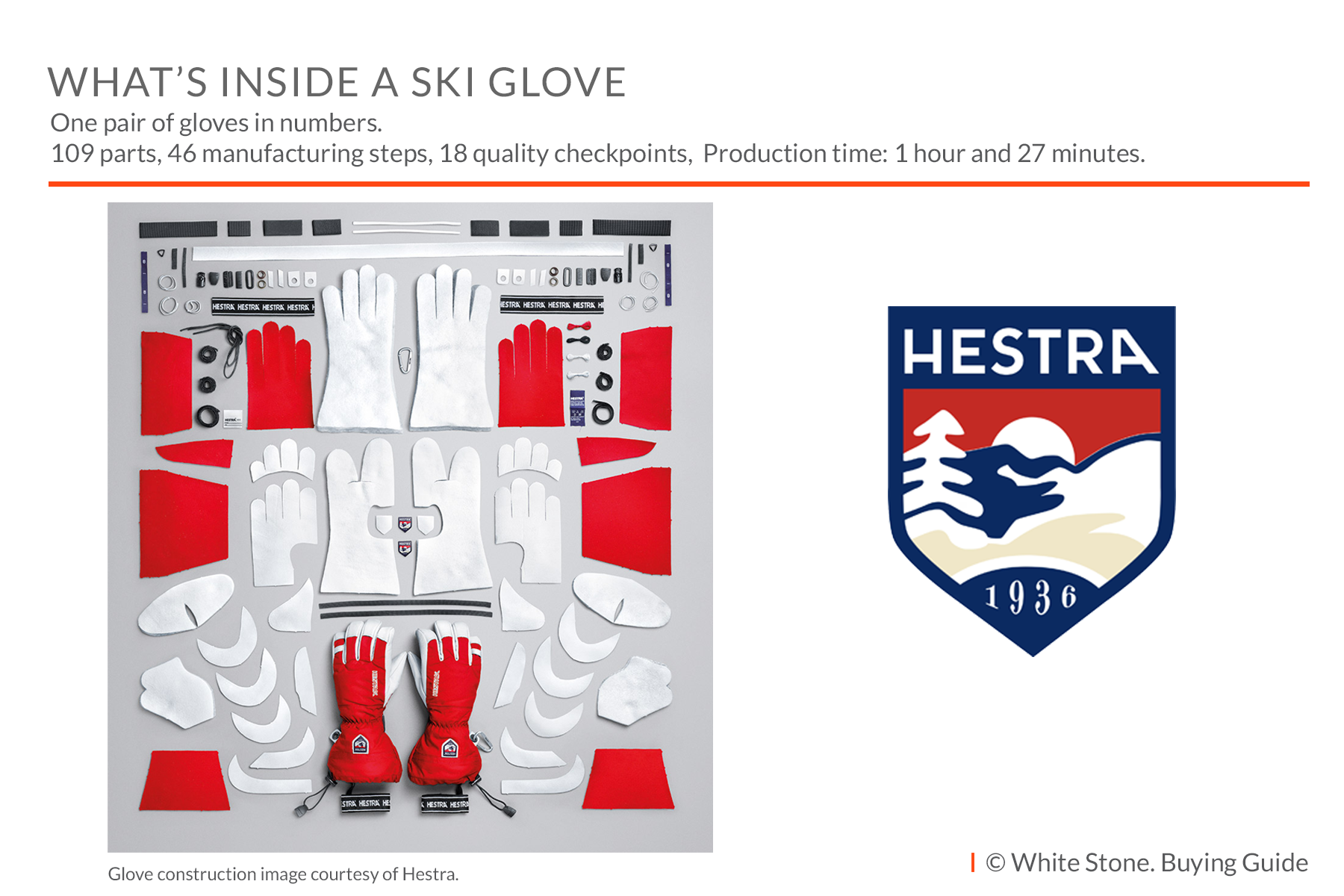
Ski gloves are generally constructed from leather, technical fabrics or a combination of the two.
Leather provides excellent feel, flexibility and grip. Technical fabric gloves can offer excellent weather protection, while reinforced palms and fingers often use rubberised or other high-grip materials to improve durability and grip on ski poles and lifts.
Inside the glove there may then be insulation, a waterproof membrane and a separate lining.
PrimaLoft® is one of the best-known insulation materials used in ski gloves, but it isn't the only indication of quality. Manufacturers such as Hestra, Reusch and Bogner also use excellent proprietary insulation technologies.
Rather than choosing a glove purely because of the name attached to its insulation or membrane, consider the complete glove: its fit, warmth, construction and suitability for how you ski.
How to Keep Your Hands Warm While Skiing
Buying a warmer glove isn't the only way to keep your hands warm. How you use and look after your gloves throughout the day can make a significant difference.
Keep Your Gloves Dry
Insulation works by trapping warm air generated by your body.
As insulation becomes wet, its ability to retain that warm air is reduced. Keeping both the outside and inside of your gloves as dry as possible is therefore important.
Keep Them Warm When You Take Them Off
We often see skiers arrive at a mountain restaurant feeling hot after a run, remove their gloves and leave them on an outside table.
You may feel hot at that moment, but your gloves could be sitting in an air temperature of -2°C or colder. The air and moisture within the insulation are cooling while you are doing the same.
When you put them back on, you are putting cold gloves onto cooling hands.
Add Glove Liners
If you still struggle with cold hands, liners are a useful next step.
We stock both silk and merino-wool glove liners. Silk is extremely thin and comfortable, while merino wool generally offers a little more warmth.
Keep your liners in a warm internal jacket pocket rather than a cold rucksack. If you need them later in the day, they will already have retained some warmth.
Heated Ski Gloves
For some skiers, particularly those with poor circulation or Raynaud's, insulation alone may not be enough.
Insulation doesn't create heat. It retains the heat reaching your hands through your circulation. If very little warmth is reaching your fingers, simply increasing the amount of insulation has its limitations.
Heated ski gloves provide an additional source of warmth.
We stock Hestra heated gloves because our experience and customer feedback have been excellent. They are a significant investment, but for somebody whose skiing is regularly spoiled by painfully cold hands, they can be worthwhile.
We have tried lower-priced heated options in the past but experienced too many failures and returns. If somebody relies on a heated glove, a failure during a ski holiday can be particularly uncomfortable, so reliability is extremely important.
Protect Your Gloves from Ski Edges
One type of damage we unfortunately see is caused by ski edges.
Modern ski edges are made from hard, sharpened steel. They are designed to cut into firm snow and ice and can also cut leather and reinforced synthetic glove materials remarkably easily.
Be careful when carrying and handling your skis and never slide your gloved hand along a ski edge.
There is no practical glove material that can be expected to withstand being drawn across a freshly sharpened high-quality steel edge.
Damage caused this way is accidental damage rather than a manufacturing fault and would not normally be covered by a warranty.
Glove Handcuffs
Glove handcuffs are a simple but extremely useful accessory.
Some gloves have wrist straps already attached. If yours don't, separate handcuffs can be fitted to many styles; we stock Hestra handcuffs in different sizes.
They allow you to remove a glove to answer your phone, check a piste map, apply lip cream or adjust equipment and simply let the glove hang safely from your wrist.
They are particularly useful on chairlifts, where a dropped glove can be difficult — or sometimes impossible — to retrieve.
Drying and Caring for Ski Gloves
Wet gloves lined up in front of a fire or placed directly onto a hot radiator are a familiar sight in mountain restaurants.
Avoid doing this.
Waterproof membranes are extremely thin technical layers. Excessive heat can permanently damage a membrane, and that damage may be completely invisible from the outside.
Leather also dislikes excessive heat and can become dry, stiff or damaged.
Allow wet gloves to dry gradually at a moderate temperature rather than trying to dry them as quickly as possible with intense heat.
If very wet conditions are forecast, an even better solution is to carry a completely dry spare pair in a small rucksack.
Why Children May Need Two Pairs of Ski Gloves
A spare pair is particularly useful for children.
Even good young skiers fall, play in the snow and throw snowballs. By lunchtime their gloves can be considerably wetter than they realise.
They then put the same wet gloves back on after lunch and spend the afternoon complaining about cold hands.
The solution is simple: a morning pair and an afternoon pair.
If you have a limited budget, your child may have warmer hands with two pairs of affordable ski gloves rather than one top-of-the-range pair.
Wet insulation cannot trap warm air effectively.
The White Stone View
If you are buying your first ski gloves, concentrate on fit, waterproofing and warmth.
Choose a waterproof glove and make sure there is a little room around your hand and fingers. If you have to struggle to put the gloves on when everything is dry, they are probably too small.
Once you have a reliable waterproof pair, other gloves can give you more options. A fully breathable leather glove can be excellent in cold, dry conditions, while a lighter glove can make warm spring skiing considerably more comfortable.
Keep your gloves as dry as possible, keep them warm when you take them off and never try to speed up drying by placing them directly on a very hot radiator or in front of a fire.
And if none of the gloves you try fits properly, try another brand or style before compromising.
There isn't one perfect ski glove for every skier or every day. Understanding the compromises will help you choose the right glove for your hands, your skiing and the conditions.
We hope our guide has helped you understand how to choose the right ski gloves. If you have any further questions, please get in touch—we're always happy to help.
© White Stone. Buying Guide.
Based on over 20 years of fitting premium ski wear and more than 40 years of skiing experience.